Archives for posts with tag: vacation

The linking theme to yesterday’s picture is water and stone. I find it amazing how such a soft material like water can do so much damage to hard stone. I guess, persistence is the key.

On the West Coast of Auckland water shows it’s toughest face. The force of the element demands its well deserved respect, particularly on a wet and windy day like yesterday.  The constant pounding of the Tasman Sea has carved beautiful cliffs into the land. High on one of those natural cathedrals a colony of gannets has found their place. They usually gather on rocks just off the mainland, only three colonies in New Zealand have settled on the mainland itself. Winter is not the best time to see the birds, the colony is pretty deserted. They will come back for the nesting season in spring.

When we have overseas visitors – as we do at the moment – we like to make this our first trip for a real New Zealand experience. The beaches on the West Coast are high in iron and their colour is black, rather than yellow or white.
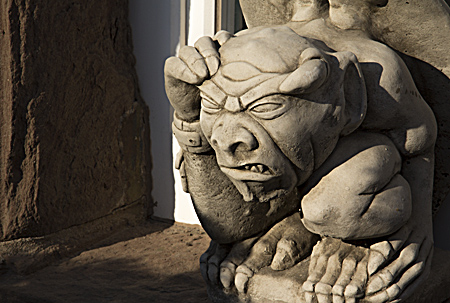
I am staying with the cathedral theme today. I like the little devilish figures on medieval churches. Their function was to scare people into believing. The masons of old had such great imaginations about what the afterlife would look like. As literacy wasn’t widespread the stories had to be told by easily understood pictures and sculptures like these. Of course the stories were also told orally, but we all know a picture is worth a thousand words.* Apart from this, the sermon was held in  Latin, so most people didn’t understand what was being said. These sculptures were a great support in keeping the congregation in line.

I don’t know if it happens to other people as well, but I fall in love with the sound of words. The word gargoyle is one of my great loves. To my ears it has a ring like a mischievous giggle. I always thought the devilish goblins at churches are gargoyles, but I am mistaken. The figure here is technically a Grotesque. A Grotesque’s function is solely to scare people. The Gargoyles are the figures that also function as waterspouts to channel the water away from the masonry and  protect the building from water damage. I finally found out that gargoyle describes the water channel function itself, not the goblin. How un-poetic. In  German they are just called waterspout, or as my dictionary tells me: Gothic waterspout with grimace, now that is a mouthful.

*BTW in German the saying goes: a picture says more than a thousand words. Does this mean the Germans are bigger wafflers?

This is from my X collection. An image painted with light. When you start photography, this is an absolute must: you have to try painting with light at one stage. It is great fun. This one really enriched my collection of X’s.

I have to keep it short today, as I spent too much time on the phone to Germany this morning. I have a visitor arriving tomorrow and I wanted to wish a safe trip. I am pretty sure over the next couple of weeks I will write more about the tiny differences between Germany and New Zealand as it will come up in conversation a lot.

I hope my puppets won’t get neglected too much, I will have to think something up so this won’t happen.

My idea with the Chinese Whisper caused me considerable pain last night. In my head I went through my image collection and found, now, that I really had to think about how I can link images together without it seeming forced.  … Then, I couldn’t find the image I wanted to use today on any of the hard drives at home. It is definitely in my master collection at work. Finally I decided to use this one here, which is the ultimate motion picture. It is the motorway just South of Auckland late at night taken from a moving car using a long exposure (I was bored!). I also moved the camera around to get an erratic pattern. I dislike photographs of cars.

The motorway is another thing that is totally different here than in Germany. In Germany motorways connect different cities, so they are a  fast route through the country side. In New Zealand the motorways take you through the cities. They are a quick route to different parts of the metropolis, in particular Auckland. More than half of the not even 200 kilometers of motorway we have in New Zealand are within the Auckland Region.

Yesterday’s image was the “yang” to the old lady in the post lonely path (“yin”). The bare trees, the coldness and the male person climbing up the stairs into the light, while the old lady walks into the darkness…

When I put yesterday’s image up, I remembered this one here, which I always like for it’s colours. The image yesterday was taken in the ruins of an old castle in Germany. The castle dates back to 914 and sits on top of a volcano not far from Lake Constanze.  Meanwhile at the other end of the world, New Zealand wasn’t even inhabited by humans at this time. The first Moa-hunters arrived here around 1300. (The Moa is long gone, people are still here). The picture in this post was taken in some defense tunnels that were built into a volcano at the harbour entrance to Auckland. They were build in the 1880’s  when there was a scare of a Russian invasion.

I really enjoy going through my images for my blog. Putting some up, one by one, makes me realise that I actually do have recurring themes. Loneliness and isolation obviously rate very high. But don’t send the men in white coats along, I am perfectly normal :). My images are just a counter balance to daily life, they help to de-stress.

This image was taken at the eeriest place I have ever been to. A place called Prora. We stumbled across it by accident too, which is quite difficult, as these steps belong to a building that is 4.5 kilometres long. Yes, four point five! And worst… it is only 150 meters from the beach.

It is a concrete legacy of the crazy man that ruled Germany a life-time ago. The complex was planned as a seaside resort for 20 000 workers but was never finished. As it belonged to  the Eastern part of Germany, the Soviets established a military base in there after 1945. They dismantled some of the buildings, relocating all of the re-usable material, leaving bare brick skeletons behind when they moved out. In the late 1950’s the Eastern Germans took over and put some finishing touches on the building. It was then used as a National People’s Army camp until the Wall came down in 1989. During this time it was a restricted military zone, therefore a no go area. The checkered history continued after reunification. The German Army (Bundeswehr) utilised it for a while and it was used as a Refugee camp for people from the Balkans. In 2011 a Youth Hostel opened up.

When I was there (2007), only one of the blocks was used. It housed a museum outlining the history of the building and the history of the National People’s Army (Eastern German Army). The rest was 4.4 kilometers of gutted buildings in various states of decay.

The whole thing is like a snake. All rooms have a sea view, so the building is very narrow.  The picture below shows the seaward side.

On the side away from the sea runs a corridor and every 100 meters or so there is a staircase extension, where the washrooms are located as well. These extensions are depicted in the image below. So you walk for miles alongside this building always seeing the same thing.

This place has all the recent German history packed into it. This makes it so eerie for me.

I leave you alone with this one today.

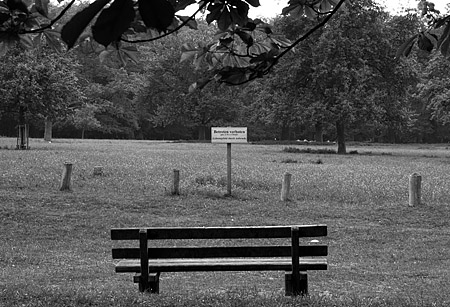
I find this image  typical of my childhood. The sign, right wham bang in the middle, says “Betreten Verboten“, which means KEEP OUT. This sign turns everything beyond that point into a living picture, just like a stage or TV. It is the lushest most beautiful landscape, but…  all you can do is sit and watch. Over in the distance at the edge of the trees, the little white spots is a group of grazing deer. It is  a very peaceful living picture. Of course, I know now, without the sign there would be no lush and beautiful landscape. It would be trampled all over and the deer would be scared deeper into the woods.

There were a lot of Betreten Verboten Signs scattered around my life and I believe this is one of life’s great lessons: To learn which ones need to be obeyed, which ones can be safely ignored and which ones need to be fought against.


This is another one of my favorite images, even though not many people I showed it to share my excitement. Actually nobody I showed it to liked it, but then I think only a handful of people have seen it so far.

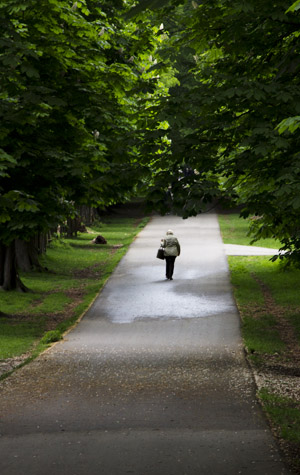
I admire the old lady, holding tightly on to her handbag, striding out with great determination. Her crooked body still exudes purpose. There is no waiver in her gait. Straight down the middle, protected by spring-green chestnut trees. These trees have been around for centuries and have seen many old ladies passing by. (Yes, I do understand why other people might not get excited :)

Yesterday I had some time to do more research on the Internet regarding the puppet world. I found some amazing stuff overseas, but New Zealand looks pretty grim. There is a “Puppeteers in New Zealand” organisation. But their website (Pinz.org.nz) has a very neglected feel. There is a forum with 13 members but it is locked and the last entry was 2010.

There are of course puppeteers for children around and there seems to have been a New Zealand Puppet Theatre founded by Annie Forbes in 1984, which was going for some years. Annie Forbes, a third generation puppeteer, has moved to Australia.

The funniest thing I found was on Wikipedia (puppetry subhead oceania). There are a couple of good paragraphs about Australia and then – New Zealanders hold onto your seats!– one sentence: “In New Zealand, a similar history has taken place.” That’s it! Thinking about it now, that might be because all the good puppeteers have moved across the Tasman (see above).

I am going to finish Push-Push today.