Archives for posts with tag: reflections

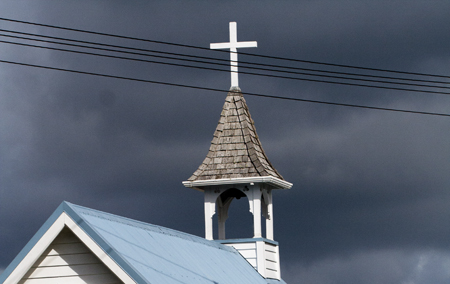
The connection to yesterday’s image is the cross. The X in the light painting could not deny it’s relationship with this symbol here. It is a beautiful light in this image and I love the stark white against the black cloudy sky. The meaning of the power lines severing the symbol from its base, I leave up to you.

Religion is a subject matter I usually avoid. All my life I knew there are two things I would never become: A revolutionary or a missionary. I lack the necessary conviction for either. This doesn’t mean that I don’t have a view point. In fact, I have very strong view points, but I also believe that opinions can differ and still remain friends.

I have a Bible though and I remember how I got it as there was a great lesson attached to it.

I was raised a protestant and when I was fourteen I went to prep classes for Confirmation. For the actual event, the congregation shouted each of us a “new entrants” Bible. The Bible came in two colours: red or blue. So the pastor asked the thirty of us which colour we would like, so he could order them. First red – heaps of hands went up. Then blue – only one hand was raised. Oops… everybody laughed and looked at me. It was a truly embarrassing moment, but I didn’t change my mind. I simply couldn’t imagine a red Bible.

When the Bibles finally arrived, the red was a totally obnoxious shade and I had around twenty-five offers to swap my blue one. I still have the blue one in my bookshelf.

I really enjoy going through my images for my blog. Putting some up, one by one, makes me realise that I actually do have recurring themes. Loneliness and isolation obviously rate very high. But don’t send the men in white coats along, I am perfectly normal :). My images are just a counter balance to daily life, they help to de-stress.

I leave you alone with this one today.

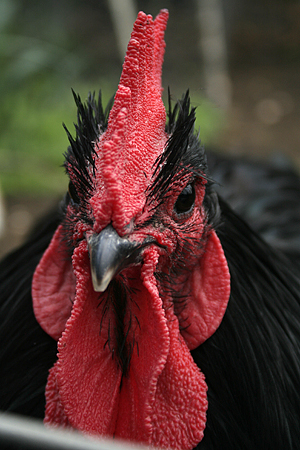
Doesn’t this rooster look mean?

…Sorry, this is a human’s interpretation of an animal’s facial expression. Of course I have no idea what’s going on in his head. But he is certainly eyeballing the viewer. You have to admit he is an absolutely gorgeous creature.

A lot of things put us off at at first sight, but when we look again we might discover the beauty in the beast. Unfortunately we have the tendency to make our judgements hastily and move on to the next thing, always worried we could miss out on something important. We skim and skip all day long. Unfortunately this has quite the opposite effect: We miss a lot. Photography is a magnificent tool to stop the world and look again.

I have one friend who doesn’t want to look at my puppets. He finds them disturbing. Fair enough, but he won’t elaborate on what puts him off exactly. I would be so interested. Not everybody has to love them, but I am curious what they trigger in different people.

The stories that go with the puppets are of course reflections of my own experiences with people. Creating the puppets and writing up their traits is very therapeutic. While photography is a discovery of the visible world, making the puppets enables me to explore the non-tangible world, primarily relationships. When I have finished a puppet, I have looked at so many different angles of the same issue. While I still might not like the situation, I will have a better understanding and most importantly I will have kept my sanity in the process. For me they are like voodoo dolls gone peaceful.

On Saturday there was a really good article in the local newspaper about How the Web messes with our minds. I should  be careful when I say really good, as we tend to like opinions that fit with our world view. We can remember things that support our own ideas much better than conflicting ideas.

Anyway, the article talks about first emerging research that the social networks can make us:

not just dumber or lonelier but more depressed and anxious, prone to obsessive-compulsive and attention-deficit disorders, even outright psychotic. Our digitised minds can scan like those of drug addicts.

It is very gloomy, more than one in eight people supposedly show an unhealthy relationship with the web. I guess this can be added to the list of alcohol, cigarettes and pain killers…

The article was in the NZ Herald, July 14, A24. Reprinted from Newsweek.

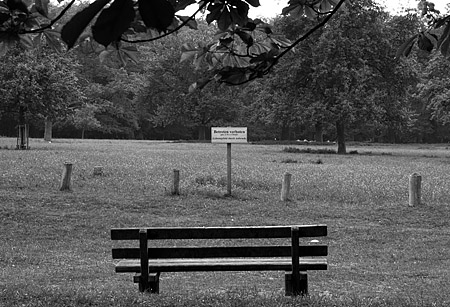
I find this image  typical of my childhood. The sign, right wham bang in the middle, says “Betreten Verboten“, which means KEEP OUT. This sign turns everything beyond that point into a living picture, just like a stage or TV. It is the lushest most beautiful landscape, but…  all you can do is sit and watch. Over in the distance at the edge of the trees, the little white spots is a group of grazing deer. It is  a very peaceful living picture. Of course, I know now, without the sign there would be no lush and beautiful landscape. It would be trampled all over and the deer would be scared deeper into the woods.

There were a lot of Betreten Verboten Signs scattered around my life and I believe this is one of life’s great lessons: To learn which ones need to be obeyed, which ones can be safely ignored and which ones need to be fought against.


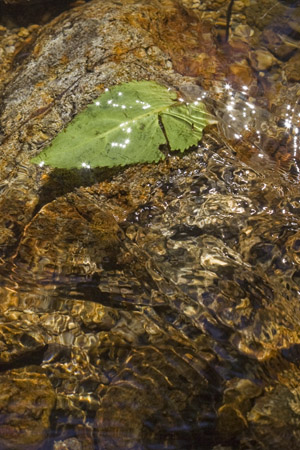
I love this image of the submerged leaf with the fairy dust specular highlights, and the water softly flowing past. It’s very peaceful and calming. It’s almost as if the leaf is being caressed by the water.  I love to hike up the mountains here. Rivers bathed in sunlight look like melted gold. (Yes, …there is gold up in them mountains.) And you return home so much richer.

What was clear and crisp yesterday, is out-of-focus today.

I will have a bit of a rant today. It’s a pacman day: that means I have hit the wall and need to get unstuck before the ghosts get me. Pretty sure you all know the game.

I have noticed that my book is listed in an online shop of a large New Zealand bookstore chain. (Of course it is, as it is in the Nielsen database and I assume they just republish this database). However this online store shows the book as currently unavailable, which irks me, as it is not unavailable at all. To the general punter it sounds as if it were out of print. So we wrote a nice  letter to the chain with a fact sheet about the book, asking whether they would consider stocking the title as they have it in their database anyway. We even offered them to send an evaluation copy.  It didn’t take them much more than an hour to respond and say it is too specialised. Mmmhm I wonder how they came to that conclusion without engaging.  Furthermore they told us they will take it off the database. (Which is difficult, since I believe they just re- publish the Nielson database). Later on that day we got another email saying they won’t take it off the database, but just order a book from us if someone asks for it. Surprise! But nothing achieved.

This got me thinking about the whole publishing world again. I am stuck between a rock and a hard place. My book could be viewed as a vanity book or self-published as I am a partner in the publishing house that published it. What is a ‘real publisher’? After all I studied publishing for 3 years and set up a publishing house before, which I successfully sold. I adapted my career path when I came to New Zealand as I wasn’t confident enough with the language. I moved into writing computer books for the German market. I have been sole or co-author of around 30 books. So I wouldn’t really call myself a novice. But gee I am happy that books are not cream cakes and we don’t have to sell them by the weekend. Thankfully, they won’t perish.

Of course not much has changed in the publishing world since Gutenberg… until the Internet came along. We all know that. Generally I am very much in favour of the institution of “the publisher” to ensure quality through the editing process and vouching for well researched and well written stories. But it reminds me so much of the time when computers started to move into offices. I met a lot of 40-year-olds then who said they don’t have to learn computers, it won’t affect their work at all. Ten years later they were too young to retire, but unable to find a job without computer skills.

Enough of the ranting!

On a more positive note: I met up with a friend yesterday to discuss the puppeteer workshops and it is all looking good here. I’ve nutted out a session plan which I will fine-tune after the discussion we had. Then we will take it to the next stage and test it with a group of people. This is volunteer work and I am really curious how it will all pan out.

The biggest hurdle I face is that there is the common misconception, particularly in this country, that puppets are only for children. I have been warned! In Europe, on the other hand, there are some amazing permanent troupes with elaborate stage shows. My puppets are different, as they are not professional performers. With my workshops I want them to become confidants for the participants. I would so love to unleash their creative juices.

This image is a close-up of a spider web with dew. It is an allegory of what’s going on in my head at the moment. I have all these great and sparkling ideas but the path there…

I want to share a couple more surprising tidbits from my reading lately.

So, the reigning powers tried to marginalize popular theatre  (I am not just talking about puppet theatre, but all forms of entertainment for the masses). In the article The golden age of the boulevard Marvin Carlson describes the rise of popular theatre from  fair ground attraction to permanent stages around the Boulevard du Temple in Paris, where all the entertaining stages conglomerated. The Boulevard got the nick-name Boulevard of Crime in the 1820s, not because it was dangerous to go there, but because what was on show. The Almanach of Spectacles  1823  published the numbers of crimes performed on the stages (for twenty years):

… Tautin has been stabbed 16,302 times, Marty has been poisoned in various ways 11,000 times, Fresnoy has been murdered 27,000 times, Mlle Adele Dupuis has been the innocent victim of 75,000 seductions, abductions, or drownings, 6,500 capital charges have tested Mlle Levesque’s virtues and Mlle Oliver, whose career is scarcely launched, has already tasted the cup of crime and vengeance 16,000 times.

Sounds like a normal year on TV to me.

John Houchin recounts in his article The origins of the cabaret artistique how the cabaret moved from a place where artists performed their own material for their peers to a public establishment to make money.

By 1900 the cabaret had become a competitive, commercial undertaking. Owners and producers had to devise a point of difference to stand out and attract audiences. The Cabaret de l’Ane Rouge (Cabaret of the Red Ass) had a large fresco depicting the crucifixion of a large red ass. Singers presented café-concert fare and the announcer was a huckster who encouraged the audience to drink. In the Cabaret du Néant (Cabaret of Death) visitors were served at coffins and lighting was provided by corpse lamps. The Cabaret du Ciel (Cabaret of Heaven) featured harp music, a master of ceremonies dressed as priest and a man costumed as an angel sprinkled the audience with holy water. The Cabaret l’Enfer (Cabaret of Infernal Regions) offered the alternative to celestial bliss, a glimpse of hell: The decorations that hung from the ceiling were sculptures of bodies writhing in pain.

All I can say: Move to the side Goths. We have seen it all before :).

Both articles were in Schlechter, J. (ed), Popular Theatre, Routledge 2003.

This image was taken on an island in the Baltic Sea, called Rügen. I think every German knows the scenery, it has been made famous by the romantic painter Kaspar David Friedrich. Even though the scenery is engraved in the common German memory, I don’t think that quite as many people have actually seen the white cliffs in nature. The island belonged to Eastern Germany when the country was still divided. It was military territory and therefore out of reach.

It is a mystic place, I could not describe it any differently.  We went there in winter (summer might be a different story), and we had the place all to ourselves. The image I had in my post Friends!? was taken at the same place, but at the bottom of the cliffs.

When I look at this image I can hear the silence of the place and feel the protection of the trees all around me. I can feel the springy layer of humus under my feet and smell the damp moss. It is a huge problem I personally have as an image maker in that only I have all this additional information that went into the image and everything comes back instantly when I look at it. My images are always personal memories and this is the reason why I am hesitant to share them. They might evoke emotions in other people, but what the viewer feels will always differ from what I felt.

Of course we all know that advertising imagery is build on the common memory. It is never-fail generic  imagery that evokes feel-good moods. But what is going to happen when we sit in front of the computer day in, day out and never learn what damp moss smells like. Will these images still work?