Archives for posts with tag: story

In my post yesterday I mentioned the ark we have parked in our front yard. Here is a picture of it. It is such a New Zealand thing to have a boat in the garden. Sadly you don’t see it quite as often as you used to. It was such an expression of the relaxed life-style we used to have… Still, many New Zealanders have life-time projects on the go: Restoring cars, doing up houses, building boats…

This one here is a beautifully hand-crafted wooden catamaran, built by hubby. The image is a few years old, when she had just moved back into the garden for an overhaul. It was taken in the back yard. In the meantime, a bit closer to re-launch day, she has moved around the house to the front. And she will move back into the wonderful Auckland playground, the Hauraki Gulf, before summer, to make room for our next big project…

Writing is one of those procrastinating tasks. When I don’t do it on a regular basis, it will fall by the wayside. Nevertheless, I will give it a break over the weekend. My visual Chinese Whispers has come to an end and I will go out and take new photographs. I am pretty sure I will pick up writing on Monday again. I certainly hope I will have captured some images that are worth showing :).

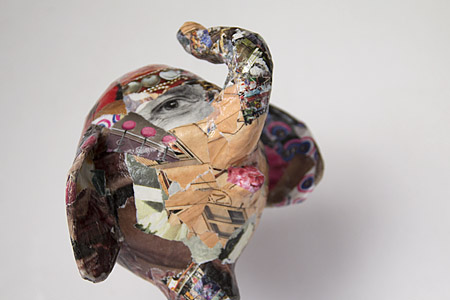
The connection to yesterday’s image are the wings, otherwise they have nothing in common. I could easily write a twenty page essay about the meaning of this photograph, which is called Fly shit on the world, but don’t worry, I won’t. It is obvious that there are many different layers to it.

It is another example of the images I thought would only appeal to me as the artist. I was surprised the other day when I had it up on my screen at work and a friend walked in and said to me: “Print this on A1 and I’ll hang it up.”  Before I could be flattered he added “What is it?”  I guess he must have been attracted to the colours in the first instance. I couldn’t enter into a discussion with him, he was gone as quickly as he had come and along the way lost his chance to get a print-out of this one. I am happy to give him another one of my images though, one that is more easily understood.

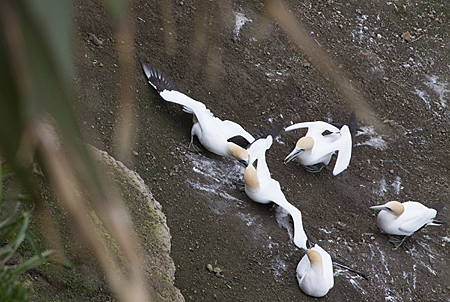
More of the  gannets today.

It was an advantage that there weren’t as many birds as there are in summer. It made it easier to observe how the birds interact with each other. They are very noisy creatures. There is constant screeching and squawking. After all, they have to out-scream the thundering water and howling wind. And if the wind comes in from the sea, the smell can become unbearable. It was an offshore wind last Sunday.

The situation in the picture here reminded me so of a schoolyard scuffle. Two birds started to have a go at each other. One was egging them on, a third one was watching from a distance. The last one pretended to only be remotely interested. His only concern seemed to be whether he had to move or could stay. They were going at it for quite a while.

Since today is more about documenting the gannets rather than an artistic interpretation, I have added another close-up image. Doesn’t he look like a winner?

I would love to have a new lens, to get even closer next time.

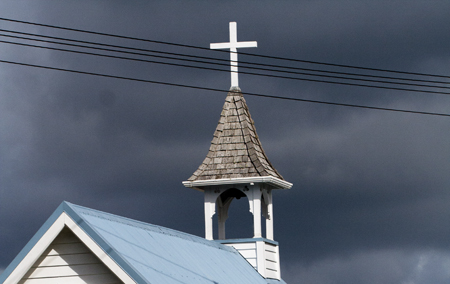
The connection to yesterday’s image is the cross. The X in the light painting could not deny it’s relationship with this symbol here. It is a beautiful light in this image and I love the stark white against the black cloudy sky. The meaning of the power lines severing the symbol from its base, I leave up to you.

Religion is a subject matter I usually avoid. All my life I knew there are two things I would never become: A revolutionary or a missionary. I lack the necessary conviction for either. This doesn’t mean that I don’t have a view point. In fact, I have very strong view points, but I also believe that opinions can differ and still remain friends.

I have a Bible though and I remember how I got it as there was a great lesson attached to it.

I was raised a protestant and when I was fourteen I went to prep classes for Confirmation. For the actual event, the congregation shouted each of us a “new entrants” Bible. The Bible came in two colours: red or blue. So the pastor asked the thirty of us which colour we would like, so he could order them. First red – heaps of hands went up. Then blue – only one hand was raised. Oops… everybody laughed and looked at me. It was a truly embarrassing moment, but I didn’t change my mind. I simply couldn’t imagine a red Bible.

When the Bibles finally arrived, the red was a totally obnoxious shade and I had around twenty-five offers to swap my blue one. I still have the blue one in my bookshelf.

I digressed again, didn’t I?

The blog is supposed to be about the dede puppets and it is time to introduce the latest addition to the troupe: Push-Push. She is a nice enough puppet, but she is always blowing her own trumpet. If you look past the glitter, you will find she is plain boring, and doesn’t have many ideas of her own. She loves to slip into her colourful circus gear and a real transformation takes place: “Look at me, look at me, look at what I can do” she calls out.  And then she shows you tricks as old as Methuselah. “Yawn,” I say and walk away.

A friend of mine gave me a book of short stories by Paul Gallico to read. The one she wanted me to read in particular was Love of seven dolls. I wonder why?

No, seriously… I would not have understood the story entirely, had I not started making puppets myself.

The story was written in the early 1950’s and is set in France. It is about a puppeteer, called Captaine Coq, who saves a young girl from throwing herself into the Seine by letting the puppets talk to her. The girl and the puppets become good friends, but Captaine Coq himself is a real bastard. As the girl has nowhere to go, the puppets invite her to join the show. She interacts with the puppets naturally, and endures the treatment of the Captain. After the show becomes a success, the girl finds an admirer who wants to marry her. She is set to leave and the puppets are terribly sad, but Captaine Coq couldn’t give a toss. Only at the last minute is he able to express his own love for the girl.

In the reviews the girl is always the heroine, who saved the nasty puppeteer through her love for the puppets. If I hadn’t started puppet making, I would have seen it in exactly this way. But now that I know the spell hand puppets cast on their puppeteer, I know the puppets were the real heroes and ultimately Captain Coq saved himself by creating these puppets. The girl could have been replaced by another girl or another incident. But without the puppets, he would have lost touch with the real world entirely. He could not have escaped the shell he was in, a shell that was forced upon him by war.

The story tells us he had started making the puppets in a POW camp out of boredom and he started to entertain his fellow prisoners. Through his experiences in the war he had obviously lost his believe in the good in people. The war crippled him emotionally. A sarcastic bastard in real life, he could act out his caring and benevolent side through the puppets. In this way he could maintain a little flame of warmth.

Believe me, I have thought a lot about the crippling emotional effect of war. After all I am German… Emotional coldness is a black neck swan!

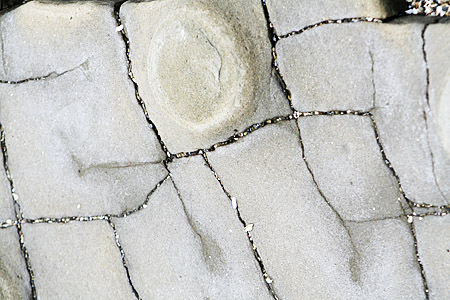
This image here I took six years ago. I like the juxtaposition of the lines with the round crater. For obvious reasons I originally called it “Square peg in a round hole.” It is just a close-up of some rocks we were climbing over at the time.

When I accidentally came across this image today, a totally different interpretation jumped out at me.

There is a little story to go with it: A friend of mine, a school teacher, was once asked by one of her pupils: “Tell me Miss, what was the world like when it was still black and white?” I just love this story. The pupil was of course referring to black & white photography and TV.  When I first heard the story, I thought it was so cute I laughed. Today, my answer would be: “The world was more colourful then…” as there must have been so much more room for imagination.

Today, when I glanced at the photograph, I instantly saw a smiling face with a rock hurled at it from a giant fist. When I showed my discovery to a friend,  he couldn’t quite follow. So I coloured it in for him in Photoshop. Now the image is called: “Honestly, I didn’t see this coming!”

However this is a very disturbing interpretation, and I went looking for another image. It took me a while, but this time it is called: “Life is beautiful!” It shows two playful figures in the sun.

Thank God you always remember what you saw last. I have difficulties seeing the giant fist now when I look at the black and white original.

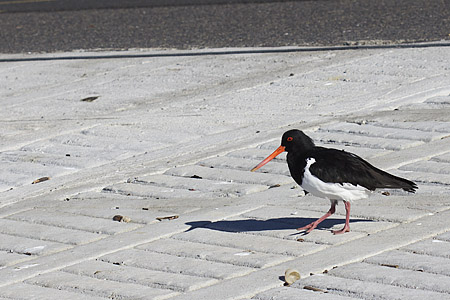
This is a bit of false advertising! I am currently trying to tie up so many loose ends. For the first time I sat down this morning and didn’t know what to write about. I have to meet somebody relatively early this morning and am therefore under some time constraint. I looked through the images I have taken recently and found this lost looking oyster catcher. The only thing to pick on this bare ramp is a plastic bottle cap.

I’ve just finished this little book called “Modern Puppetry” by a guy called A.R. Philpott. He was obviously a very famous puppeteer in his time, known as Pantopuk the Puppet Man. The book is mainly on puppet making, but touches on performing and the current state of puppetry in general. Current in this case means 1966, as this was when the book was written. I am surprised how much puppetry still seemed to have been part of society then.  But I suspect in the meantime I am just living at the wrong end of the world for puppetry.

One sentence in the book really touched me. He talks about finding material for your puppet show, he says: “Once you need them – that is as soon as you start being a puppeteer – ideas will come, a part of your mind being always alert for new possibilities – and not only for puppet characters but also for situations in which these can find themselves on stage. Plots and plays are inseparable from characters.” [p40].

Phew, so I am normal!

Yesterday I told someone a very personal story: it is one of my favorite ones, a brief summary on how I came to form my perspective. I thought I would share the story with everybody:

The pride of my hometown is a huge palace with beautifully maintained gardens. When I was a child, one of the main attractions in these gardens was a couple of swans. It was a big deal when the swans laid their eggs in spring and I wouldn’t be surprised if even the newspaper reported when the young ones hatched. Exciting stuff! However, what totally eluded me was that these swans were black-neck swans, a species native to South-America and very rare in Germany. For me they were simply the only swans I knew, so I just assumed every swan has a black neck.

When I got my first job, I moved away from my hometown. One day I went to the shores of a lake with a friend. And there they were, the beautiful white swans. White from beak to tail feather. I exclaimed: “They don’t have black necks.” My friend laughed at me and said: “Don’t be silly, swans are always white. They don’t have black necks!”

Then I moved to New Zealand and… the first swan I saw was black, entirely black. I can’t remember when I last saw a white one. I wish I still had my friend’s phone number :)