Archives for posts with tag: photography

We went down to Rotorua last weekend to show our visitor the geysers and mudpools. It is definitely a “must see” place on the New Zealand agenda. It smells like rotten egg and bubbles and steams everywhere. And no, this image is not photoshopped! This is the colour of the lake, which is called Devil’s bath. The colour stems from it’s richness in minerals, particularly sulphur. However, it can change colour depending on the ambient lighting. We were lucky, we experienced the water looking this poisonous lime green.

The area was already a “tourist” destination in the 1800’s. Travellers made the trip from Europe to New Zealand to see the Pink and White Terraces, one of the natural wonders of the world. The journey took several months, so in those days it certainly wasn’t a mass destination. Even coming down from Auckland, now a 3.5 hour drive, was a week long adventure. Starting with a steam boat and then through relatively inaccessible terrain, by horse, dinghy and on  foot.

They terraces  were destroyed by a volcano eruption in 1886, buried under a thick layer of debris.

In and around Rotorua one is constantly reminded that the earth is still active. A little bit further down the country, sixty-odd kilometers away from where we were, Mt Tongariro had a little spew on Monday night. The volcano is visible  in the distance in the image below. Nobody really knows what’s going to happen next. Yesterday I heard on the radio, Mt Tongariro could do three things: Either nothing else, or it could continue similar volcanic activity of the same strength, or it could explode big time.

Mmmhm, I could have made this prediction myself.

Don’t they look scruffy? This is a close-up of the shags who watched the airshow in yesterday’s post. These birds are fantastic divers. They can stay underwater for quite a long time chasing their prey like little torpedoes. They have less fat than other water birds and their feathers are less oily, therefore they sink faster and deeper than other birds. But because they have less oil they actually get wet.

When they come up after a dive they shake their feathers and spread their wings to dry. Unfortunately there was no sun last weekend, and they didn’t feel like hunting. I watched them for a long time sitting in the rain and I even went back the next morning.
The rain had stopped and I could capture one with spread wings sitting under the tree like batman junior.

Ah well, it was a wonderful peaceful Sunday morning.

This here is such a typical image when you try to have lunch at the lake side. It was raining again on Saturday and we were the only people having an outdoor lunch, so all the gulls hung around us. But they are actually well behaved. They waited until we were done before they swooped in and did their scavenging. No way the few crumbs that fell from our bread could have feed the entire flock. There was a lot of bickering going on.

Writing is one of those procrastinating tasks. When I don’t do it on a regular basis, it will fall by the wayside. Nevertheless, I will give it a break over the weekend. My visual Chinese Whispers has come to an end and I will go out and take new photographs. I am pretty sure I will pick up writing on Monday again. I certainly hope I will have captured some images that are worth showing :).

The last image was about feeling small and unimportant, in the sense of having absolutely no impact on the big wide world – of being incapable of making an impression. This smallness of being is the connection to today’s photograph.

In the light of a beautiful sunset the feeling of smallness is awe!

The connection to yesterday’s image are the wings, otherwise they have nothing in common. I could easily write a twenty page essay about the meaning of this photograph, which is called Fly shit on the world, but don’t worry, I won’t. It is obvious that there are many different layers to it.

It is another example of the images I thought would only appeal to me as the artist. I was surprised the other day when I had it up on my screen at work and a friend walked in and said to me: “Print this on A1 and I’ll hang it up.”  Before I could be flattered he added “What is it?”  I guess he must have been attracted to the colours in the first instance. I couldn’t enter into a discussion with him, he was gone as quickly as he had come and along the way lost his chance to get a print-out of this one. I am happy to give him another one of my images though, one that is more easily understood.

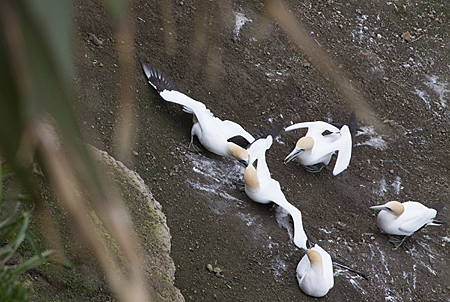
More of the  gannets today.

It was an advantage that there weren’t as many birds as there are in summer. It made it easier to observe how the birds interact with each other. They are very noisy creatures. There is constant screeching and squawking. After all, they have to out-scream the thundering water and howling wind. And if the wind comes in from the sea, the smell can become unbearable. It was an offshore wind last Sunday.

The situation in the picture here reminded me so of a schoolyard scuffle. Two birds started to have a go at each other. One was egging them on, a third one was watching from a distance. The last one pretended to only be remotely interested. His only concern seemed to be whether he had to move or could stay. They were going at it for quite a while.

Since today is more about documenting the gannets rather than an artistic interpretation, I have added another close-up image. Doesn’t he look like a winner?

I would love to have a new lens, to get even closer next time.

The linking theme to yesterday’s picture is water and stone. I find it amazing how such a soft material like water can do so much damage to hard stone. I guess, persistence is the key.

On the West Coast of Auckland water shows it’s toughest face. The force of the element demands its well deserved respect, particularly on a wet and windy day like yesterday.  The constant pounding of the Tasman Sea has carved beautiful cliffs into the land. High on one of those natural cathedrals a colony of gannets has found their place. They usually gather on rocks just off the mainland, only three colonies in New Zealand have settled on the mainland itself. Winter is not the best time to see the birds, the colony is pretty deserted. They will come back for the nesting season in spring.

When we have overseas visitors – as we do at the moment – we like to make this our first trip for a real New Zealand experience. The beaches on the West Coast are high in iron and their colour is black, rather than yellow or white.

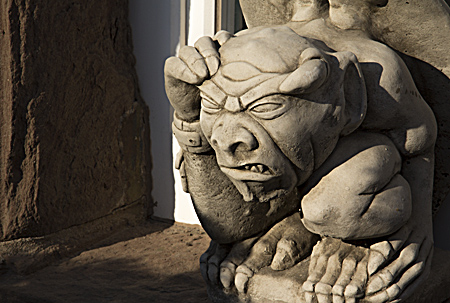
I am staying with the cathedral theme today. I like the little devilish figures on medieval churches. Their function was to scare people into believing. The masons of old had such great imaginations about what the afterlife would look like. As literacy wasn’t widespread the stories had to be told by easily understood pictures and sculptures like these. Of course the stories were also told orally, but we all know a picture is worth a thousand words.* Apart from this, the sermon was held in  Latin, so most people didn’t understand what was being said. These sculptures were a great support in keeping the congregation in line.

I don’t know if it happens to other people as well, but I fall in love with the sound of words. The word gargoyle is one of my great loves. To my ears it has a ring like a mischievous giggle. I always thought the devilish goblins at churches are gargoyles, but I am mistaken. The figure here is technically a Grotesque. A Grotesque’s function is solely to scare people. The Gargoyles are the figures that also function as waterspouts to channel the water away from the masonry and  protect the building from water damage. I finally found out that gargoyle describes the water channel function itself, not the goblin. How un-poetic. In  German they are just called waterspout, or as my dictionary tells me: Gothic waterspout with grimace, now that is a mouthful.

*BTW in German the saying goes: a picture says more than a thousand words. Does this mean the Germans are bigger wafflers?

My little church yesterday was missing it’s bell in the belfry.  This is my link to today’s image. The bell here – the largest swinging bell in the world – hangs in the Cathedral of Cologne. It is 3.20 meters high and weights 24000 kg. Absolutely gigantic. The silhouetted people  illustrate the dimensions perfectly. They are reduced to small vulnerable particles here in a world constructed by man.

The story goes  that when the bell was installed in 1924 it didn’t fit through the portal. They had to remove the main column with the statue of Mary in the entrance. It took a few weeks to move the bell into its final place, 53 meters up in the tower. It was supposed to be rung for the first time at Christmas, but after the first few warm-up swings, the rope tore. Some changes to the clapper and how it was hung were needed and it took another ten months before it was finally heard.

I wonder if it was just classified as minor set-back in the bigger scheme of things?