
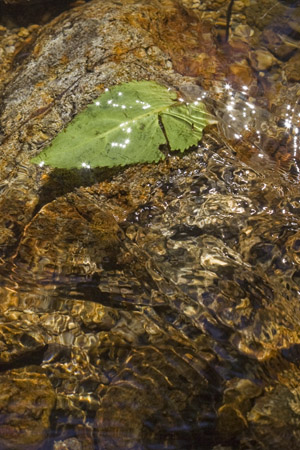
 I love this image of the submerged leaf with the fairy dust specular highlights, and the water softly flowing past. It’s very peaceful and calming. It’s almost as if the leaf is being caressed by the water. I love to hike up the mountains here. Rivers bathed in sunlight look like melted gold. (Yes, …there is gold up in them mountains.) And you return home so much richer.
Archives for category: Photography
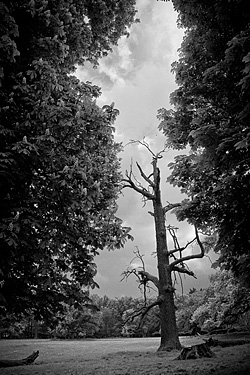 Monday morning and I am running late. Might have something to do with the Wimbledon finals and us being on the other side of the world (it started at 1 am in the morning here).
This image here is called Down the road from the fairytale garden. People who know my hometown, know where it is. It is really down the road from the fairytale garden.

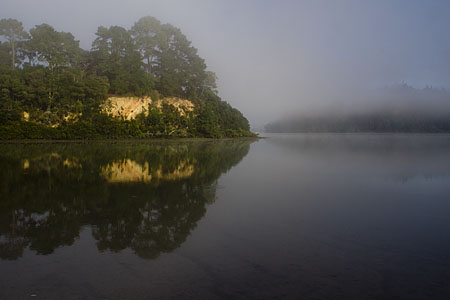
This image was taken on an island in the Baltic Sea, called Rügen. I think every German knows the scenery, it has been made famous by the romantic painter Kaspar David Friedrich. Even though the scenery is engraved in the common German memory, I don’t think that quite as many people have actually seen the white cliffs in nature. The island belonged to Eastern Germany when the country was still divided. It was military territory and therefore out of reach.
It is a mystic place, I could not describe it any differently. We went there in winter (summer might be a different story), and we had the place all to ourselves. The image I had in my post Friends!? was taken at the same place, but at the bottom of the cliffs.
When I look at this image I can hear the silence of the place and feel the protection of the trees all around me. I can feel the springy layer of humus under my feet and smell the damp moss. It is a huge problem I personally have as an image maker in that only I have all this additional information that went into the image and everything comes back instantly when I look at it. My images are always personal memories and this is the reason why I am hesitant to share them. They might evoke emotions in other people, but what the viewer feels will always differ from what I felt.
Of course we all know that advertising imagery is build on the common memory. It is never-fail generic imagery that evokes feel-good moods. But what is going to happen when we sit in front of the computer day in, day out and never learn what damp moss smells like. Will these images still work?

Landscape images are not really my thing to take. It annoys me tremendously that I can’t capture the grandness of nature. They always look flat. I usually work right at the other end of the scale in space by exploring the minute, the intimate, what’s right at your feet. Here I am often after a simplicity and a sort of flatness (for a lack of a better word). But unlike portraits of people (which I don’t ever attempt to take, except of people I know extremely well) I do sometimes try landscapes.
This morning I couldn’t decide which of the two images I should use today. They couldn’t be more different, so they have both ended up on the blog in one post. One is the weather as it is outside, the other represents more of my inner landscape at the moment. Which is which I won’t say!
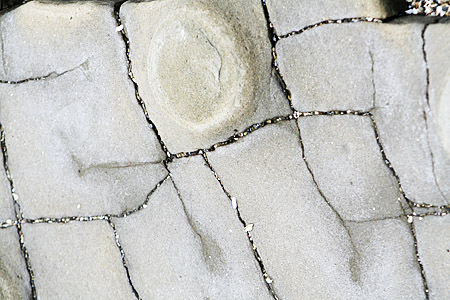 This image here I took six years ago. I like the juxtaposition of the lines with the round crater. For obvious reasons I originally called it “Square peg in a round hole.” It is just a close-up of some rocks we were climbing over at the time.
When I accidentally came across this image today, a totally different interpretation jumped out at me.
There is a little story to go with it: A friend of mine, a school teacher, was once asked by one of her pupils: “Tell me Miss, what was the world like when it was still black and white?” I just love this story. The pupil was of course referring to black & white photography and TV. When I first heard the story, I thought it was so cute I laughed. Today, my answer would be: “The world was more colourful then…” as there must have been so much more room for imagination.
 Today, when I glanced at the photograph, I instantly saw a smiling face with a rock hurled at it from a giant fist. When I showed my discovery to a friend, he couldn’t quite follow. So I coloured it in for him in Photoshop. Now the image is called: “Honestly, I didn’t see this coming!”
 However this is a very disturbing interpretation, and I went looking for another image. It took me a while, but this time it is called: “Life is beautiful!” It shows two playful figures in the sun.
Thank God you always remember what you saw last. I have difficulties seeing the giant fist now when I look at the black and white original.
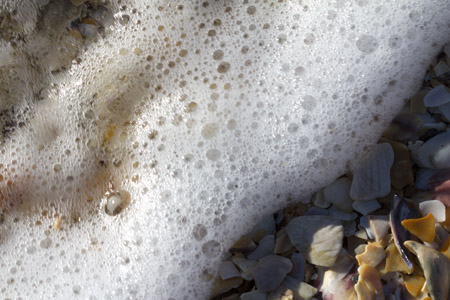
Everything around me is in flux at the moment. I am not a rock, I am a pebble.
Rocks brave the tide. They are strong and stand their position. But over time they will be ground down.
Pebbles on the other hand are small fries. They might get uplifted and swirled around, yet it is very reassuring they will settle again. A few inches to one side maybe, but there is always a chance it will be in an even sunnier spot.
For now I am happy it’s Friday again.
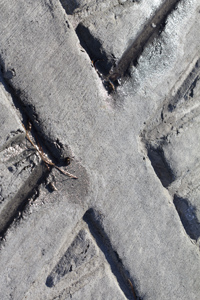 Another one of my strange hobbies is to collect images of the symbol X. I find them all around the place and photograph or paint them. This here is one of my recent additions. I love ambiguity. Maybe love is the wrong expression, I am intrigued by it.
Where I grew up x meant “No!” This is not allowed – “Das ist verboten”. Where I live now, signing off with three x means heaps of kisses. If you sign with xxxx you might be particularly fond of the person, or you might be after an Australian brand of beer. Then we have Xmas or Xing (which could be a crossing or a common Chinese name or if you are like me, you could be on the look-out for yet another x). I think x must be one the most widely used symbols with the most different meanings. I don’t have a very scholarly approach to this, this is something I will save for retirement. In the meantime I just find it interesting and keep collecting.
But ultimately, I try to find an alternative meaning to most things or try to look for a different angle. This is where my puppets come in. For me they are a little bit like de Bono’s six hats thrown into a ring and mixed in every possible combination (as nothing is ever that clear cut). Of course they are far less intellectual. But they are a fantastic tool to put yourself in somebody else’s shoes.
Logically I am now researching puppets and the history of puppetry with a particular focus on hand puppets. (I am still at the very beginning though.) Puppets have always been around. For centuries hand puppets got away with saying whatever they wanted. In public performances they could air opinions that were too dangerous for people to express. Unfortunately in Romanticism they morphed into cutesy little creatures to address kids, mainly to teach morals. Nowadays people see hand puppets and immediately think they are for children. I don’t believe the whimsical is entirely lost on grown-ups. After all animation and fantasy films are very popular at the moment. Maybe it is a matter of the readiness for consumption. Slick animation films are the instant noodles of creativity, while hand puppets are more like getting eggs and flour out of the cupboard first. Don’t get me wrong here, I don’t want to deny the creativity of the film makers. I am talking about the audience. I am a maker, but I am keen for my audience to participate. Even if it is only by filling in the gaps or spinning their own yarn in their minds.
I found various sources that use puppets for therapy with young ones, but nothing for geriatric therapy yet. I believe there is a huge potential in getting people to act out the characters, being active and letting their own creativity flow. For older people this is certainly the way to go, they don’t need to be taught morals, they are more likely to want to express their life experiences.

When I was rummaging through my old photographs yesterday on the hunt for my Tui image, I found this one as well. This was one of my first images I took with my Macro lens and I always loved it. It reminds me so much of an old weather-beaten umbrella, in fact it is a parachute perfectly designed by nature.

This is a much better image of a Tui bird, than the one I took last weekend. I have taken this one seven years ago. I remember clearly, there were no cats on the premisses… It makes a huge difference.
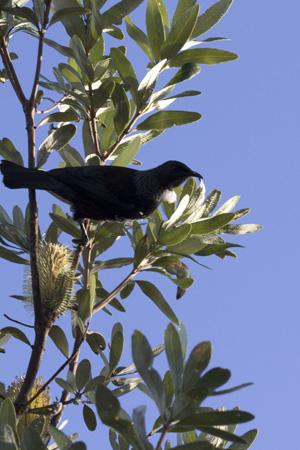 I wanted to start this day by taking a photograph of a Tui. These native birds love to congregate in one of our trees in the front garden. Their beautiful song is just such an invitation to get up and get going.
Unfortunately Tuis never sit still and it wasn’t an easy task to catch one. The sun just touched the crown of the reasonably high tree. Only one of them popped up long enough for me to get a couple of mediocre shots. It’s good that I don’t need high res images, so I could crop it drastically. It’s not an artwork, it’s just to show what the birds look like with their shiny black plumage and the two curly white feathers on their throat.
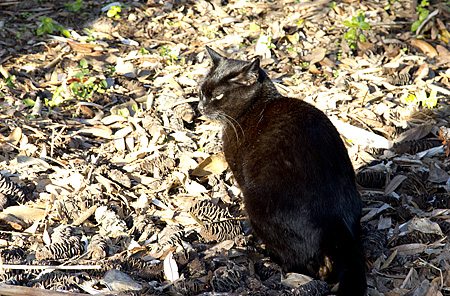
I walked around the tree to get a better angle, and there I found this mean looking little cat sitting under the same tree also waiting for the Tuis. I guess he thought the song was an invitation for breakfast.


 dedepuppets